
Contact Me: libocop@gmail.com
Bio
Name: Paul Mc Mahon
Age: 41 years old
Favourite book: Spartacus
Favourite film: Falling Down
Education
Secondary School: Belvedere College, Dublin
Third Level: UCD (English Literature, Philosophy, and Psychology)
Post-grad: UCD (Library and Information Studies)
Profile
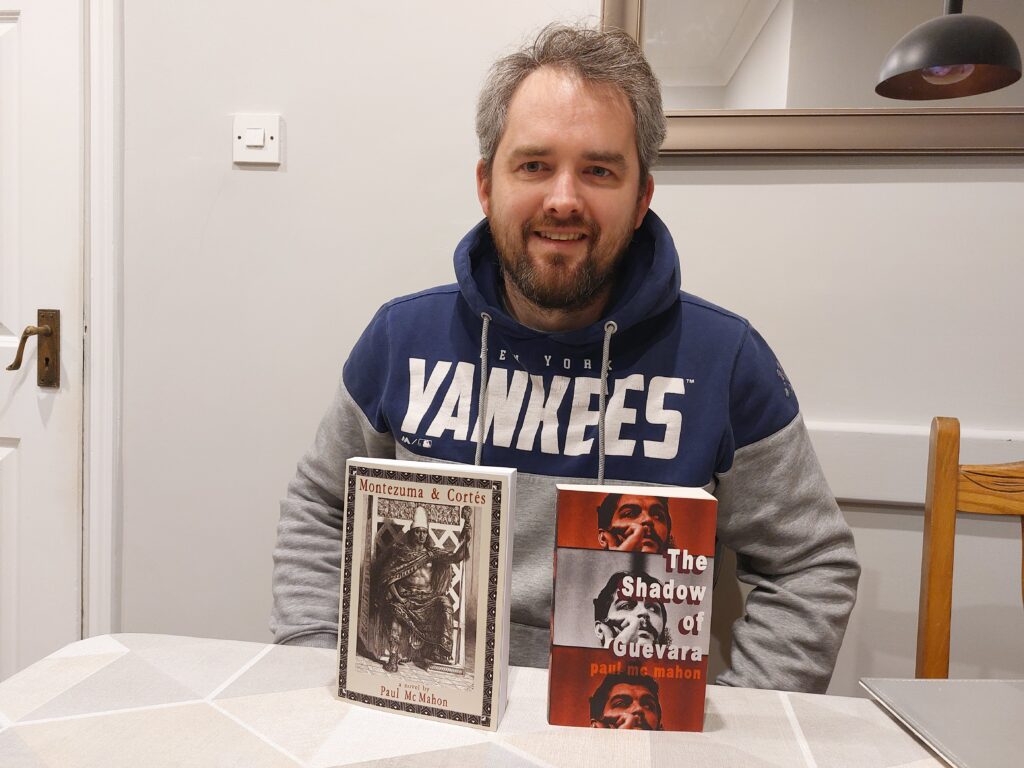
I’m a forty-one-year-old Irish librarian. I studied English Literature, Philosophy, and Psychology in U.C.D. My writing was at first autobiographical. I felt it had worth, as I have a severe bipolar condition and I have an interesting life story. But I have a special interest in Latin American history. The key figure who sparked my curiosity in this subject was Che Guevara. I have completed an 80,000-word novel on the Cuban Revolution – click here to view, “The Shadow of Guevara,” by Paul Mc Mahon – and I have travelled to Cuba, as well as all around Peru and Mexico.
“The Shadow of Guevara” builds in a steady manner, but the ball does get rolling in the opening and the story continues at a lively, entertaining pace. I have also started another novel on Francisco Pizarro and the Incas, and I have as well an another recently published historical fiction book about the story of Hernando Cortés and the conquest of Mexico – click here to view, “Montezuma and Cortés,” by Paul Mc Mahon.
More recently, I’ve looked into the areas of women’s issues and gender politics. I have just over a third of a novel written on a group of female warriors in the time of Brian Boru. Primarily, the story deals with the concept that society has been traditionally determined by a patriarchy. I’ve taken this to be factual, and I’ve aligned the story with the belief that, in pre-Judeo-Christian/Muslim times, society was in fact matriarchal.
I simply want to experiment, using a broad range of character types, to see who, or what, will come out on top, and in what way. I’ve played this out within a 10th century A.D. background, where a large group of female clan members are given the opportunity to fight, under trying circumstances, for their freedom and independence.
Extract from Montezuma and Cortés
Book VII: Tenochtitlan (November 1519)
Chapter Twenty-Two
[In which Balam describes Cortés and his men’s journey into Tenochtitlan and their meeting with King Montezuma, as well as the manner in which they were received.]
Tenochtitlan
Our train grew yet further as we marched on, filled with new additions, lords and noblemen from across the near-endless empire of Montezuma. The common folk too, who burned with curiosity and wonder, latched on to our brigades. I imagined Montezuma watching on from the Temple of Huitzilopochtli, seeing our army away in the distance, advancing over the hills towards Tenochtitlan. We were wary, ready for battle, ready for the first provocation. We moved in formation, with the Tlaxcalans in the main body of our army.
Montezuma had good cause to worry. Cortés was winning over all the lands of his kingdom. The Mexican emperor had to have heard the rumours in the air, talk that disparaged the Mexica, warning Cortés not to trust them.
Our warriors and soldiers looked constantly all around themselves, especially those in the vanguard on their horses. They were the lookout towards any frontal assault, which was the most likely. There were hounds at the head of our army, sniffing and panting and barking, leading the way forwards. Alone, ahead of the hounds, was the standard bearer, waving the flag of Castile. The wind ruffled the banner as he moved along, bearing the weight of the broad wooden pole on his shoulder.
Cortés directed us onwards, riding upon his mount, putting a hand to his forehead. The shields and swords of his men reflected the light of the sun, which, though weakened by cloud cover, must have disturbed the vision of our Caudillo. He gave a long defiant stare in the direction of Tenochtitlan. Still, there was much in the balance. War was to him a last resort.
Yet war was inevitable. There were many archers too in our train, further back, with quivers bursting with arrows. We had substituted our metal amour for the cotton armour of the Indians, as it was less cumbersome in the heat and still offered good protection. At the back of the main body stood those who supported the arquebuses on their shoulders. These they fired as our army passed through each new town. The sound of these guns, combined with the foul smell which resulted when they were fired, caused several Mexica along the way to cover their ears and hold their noses in disgust and terror. I felt shamed by their cowardice.
At length, we came through a mountain pass and made ready to enter the city before us. As we neared the southward entrance, we moved along a broad causeway which linked Tenochtitlan to the lands around the city. The king had instructed his subjects to hold back, at least at first. Our horsemen dismounted, then mounted again, only to dismount yet another time, but a few seconds later, their attention having been grabbed by some new aspect or feature of the city. They gaped at the pyramids and palaces and marketplaces of which they had heard so much. They observed the customs and formalities of the Mexica, the stalls that sold the meat of tiny dogs, and the meat of human beings. Some of the Mexica bristled to see the white men retch at this.
Montezuma moved down from his palace to greet Cortés. He was dressed in a feathered gown and sat within a richly decorated palanquin, embroidered with jade and gold. He had himself carried, on his palanquin, from his domicile, and escorted, by many lords and noblemen, to the outer walls of Tenochtitlan. These noblemen were dressed in their best finery too, with silk-like tunics, and gold sandals and necklaces.
Where the long causeway ended, the King of the Mexica first came face to face with Cortés and his men. The Mexica had brought many gifts with them, of flowers and necklaces with precious stones in them. They gave these to us. Some members of his entourage swept the ground before Montezuma’s carriage and sprayed perfume all around him. Two members of the royal guard led the king towards the Caudillo. They held each of Montezuma’s arms and supported the aged emperor across the uneven earth. The ground itself was touched by the hands of all the Mexica, who then kissed their palms. Montezuma dismissed his guards and walked unaided towards Cortés. He gave a long low bow before the white chief, who dismounted from his horse and moved forward to embrace the Mexica’s king. Montezuma noticed that when he saw the negative reaction this caused among the Mexica, Cortés simply gripped his hand and shook it.
‘You’re Montezuma?’ said Cortés.
‘Yes, I’m he,’ said the king.
He spoke further.
‘Sir,’ he said to Cortés, ‘it’s been a long and hazardous journey for you, but now you’re here. Rest well, repose in the comfort of Tenochtitlan, whose chief houses and palaces I put at your disposal. I’ll see that you eat your fill in your time here. We’ll watch over you, as a mother hen who guards her chicks. Walk the city at your leisure. See what we have to show you. Talk to the people. We’re your friends. I have foreseen your coming in my dreams, and now you’re here, and I’m glad at heart … I was sick with worry, lest you should come to some harm I couldn’t prevent.’
‘You too may rest easy,’ said Cortés, ‘for we’ve suffered no injury. The full complement of my men is here, as well as the friends we’ve made along the way.’
Montezuma failed to control a tiny sneer.
‘I’m content, at last,’ Cortés continued, ‘to have met the man I’ve sought for so long, and to see that he’s humble and gracious, like myself, like all of us Spaniards.’
They exchanged necklaces, one of gold and one of glass. Each of them hung a garland of roses over the other’s shoulders. Montezuma wore a small circular stone with an image of a hummingbird on it attached to his lower lip. There was a bone in the centre of his face, running across his nose, piercing both of his nostrils. Again, there were circular disks in each of his ear lobes. The Spaniards made faces which suggested they were disgusted by such things. Yet I sensed, behind their disgust, that the Spaniards hid an envy to replicate the same freer mode of being, to dress in loincloths and dance and drink as the Mexica did. In spite of their revulsion, I recognised that the white men were impressed by the fine feathered costumes of the Mexica. They were awed by the jaguar-skinned clothing and the fierce animal heads, with their serrated teeth, that the Mexica wore over their own heads.
Montezuma and Cortés then walked into the city, followed by the army which Cortés had assembled and all of the Mexica who accompanied their king. People gathered on the rooftops, or came to a stop in the streets, or froze in their canoes in the canals. The two leaders and their retinues walked past the Great Pyramid, with its twin towers, and reached high ground from which they could see the uppermost points of all of Tenochtitlan’s houses and ceremonial buildings.
‘Diego, close your mouth. Narrow your eyes, Pedro,’ Cortés whispered to his captains.
The Spaniards could not conceal their amazement. They spoke in pure astonishment. Many different flashes of anger passed across the Caudillo’s features; he was furious.
The emperor and the white chief stood together upon that raised platform, the highest point of elevation, looking out over the city of Tenochtitlan, surrounded by the bustling crowds. Thousands of people stood around the Spaniards and spoke in hushed voices. The Spaniards spoke quietly to each other. It was a peculiar sound to me, the noise of so many whispers, whispers of admiration, whispers of fear, whispers of suspicion …
Extract from The Shadow of Guevara
Chapter Thirty-Two
We circled the hills, trying to get our bearings. The weather at the base of the mountains was cooler, but the terrain was hard on our feet. Climbing upward at speed, over the unforgiving soil, was tough on the lungs. The same three recruits were continually in our rear, Sebastián, Juan, and Gabriel. Sebastián had grit. He’d only fallen back to help his friends. Juan was struggling and Gabriel, to be frank, was dying. I tried to push them forward, attempting to shield them from Zanetti’s awareness.
But I couldn’t help Gabriel. No-one could. It was like he was retaliating against the way he’d been hoodwinked. He thought he was going to be among good, honourable men. Instead, he was just among men, and we behaved like men do. We comforted him, almost physically dragging him along at times, giving him large portions of our water, in addition to his own. We encouraged him, tried to improve his confidence. ‘Come on, kid,’ we said. ‘It’s not that bad.’
Sebastián half carried him. Gabriel masked Juan’s lack of aptitude as well. In the end, we lost patience. We shouted at him, screamed at him: ‘Gabriel, you pussy, come on. I’ve seen tougher teenage girls than you!’ We told ourselves we were mean to spur him on. But no, we were mean because of our frustration.
He kept trying to sit down. He was crying, wringing his hands together. He pleaded with us.
‘Just give me a minute,’ he kept saying. ‘Shit guys, I need to take a break!’
Rodrigo tried our last resort.
‘Gabriel,’ he said, ‘do you want us to leave you out here in the wilderness? You’ll die like a wild animal. You don’t know how to hunt, how to feed yourself, and we’re not wasting our tools to give you. We can’t set a precedent where we release deserters into the wild and give them the necessary equipment to fend for themselves. Don’t be such a coward. Have some self-respect!’
Suddenly, Roberto blundered back into our group along with his vanguard soldiers. As he did so, one of our scouts reported that National Gendarmerie were coming in our direction. Radio broadcasts confirmed their awareness of us and their plans to surround us. Roberto was spotted on his latest expedition; some peasants had alerted the authorities. Zanetti demoted him at once.
‘You stupid son of a -’ Zanetti said, but it was time to run. He broke off in mid-sentence. We fled at speed, but after some time, fatigue coupled with the uneven terrain caused Gabriel to lose his balance. He stumbled and fell to the ground, holding his chest in pain. We others formed a circle around him. He retched and a spray of his puke landed in the dirt between his hands. He kept complaining that his asthma prevented him from moving so fast.
‘Wait … wait … please … it’s me, Gabriel … your friend …’
Our commanders bristled at the sight of his tears. We had no time for this. They instructed a few of us to place a bag over his head and to tie his hands behind his back. We, his fellow soldiers, no longer seeing his eyes or his wisp of a moustache, turned away nonetheless. If he had any friends among us, we said nothing to try to save him. We would only have shared his fate.
We continued to stand around him with our rifles. The ones who had tied Gabriel’s hands listened to him plead, but they gave no sign of hearing him. This wasn’t how we believed things would be when we joined Zanetti’s cause. Before enrolling, we anticipated travelling a path to a more enlightened society. This was worlds away from that, like a scene from the Dark Ages, as though Gabriel was positioned in front of us, standing on the gallows with his head in the noose.
Zanetti stepped forward. There, among the trees, he shouted at Gabriel to die like a man.
‘You miserable coward. Have you no sense of shame?’
Despite it all, I didn’t sense what was coming. It happened so fast I didn’t have time to react. I’d seen a lot of death up close, but never the execution of someone I’d known any way well before. After it happened, I sort of went catatonic. I moved, but I wasn’t with it, even a small bit.
Gabriel coughed, struggling to catch his breath. He rasped some unintelligible words, something about mercy, something that seemed like an apology. Zanetti grabbed Gabriel by the shirt and, breaking the circle, he dragged him outside its rim. Keeping his back to the rest of the men, Zanetti aimed his 9mm Browning at Gabriel’s brainstem and fired. Many birds fluttered into the sky, but the sound of the gunshot didn’t jolt us. Gabriel’s death was on the cards for some time.